
What happens when content isn’t removed, but no one sees it? New research from OBSERVACOM, the I&D Forum, and Digital Action, analyzes the impact of shadow banning on freedom of expression, public debate, and information pluralism
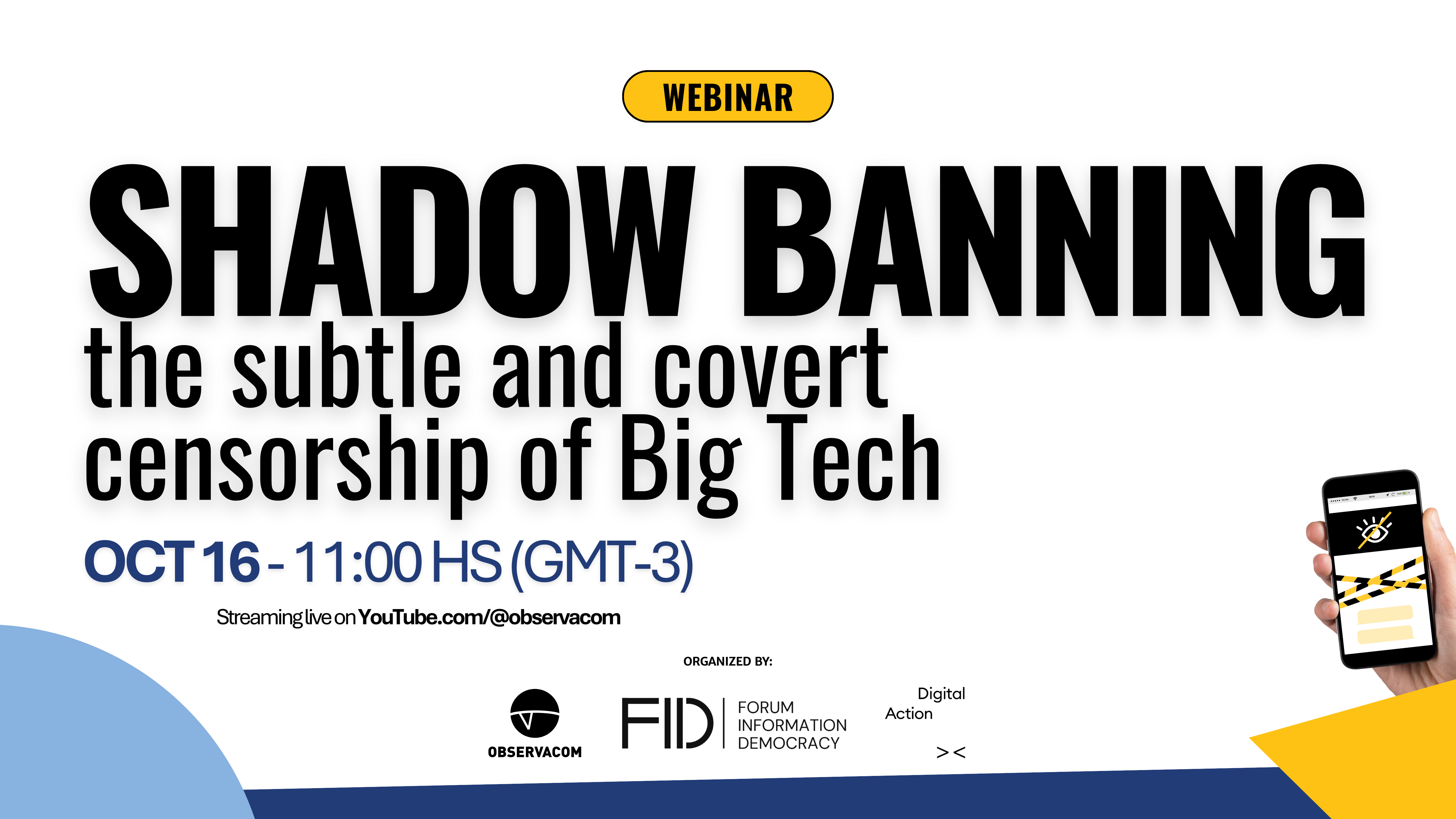 OBSERVACOM, together with the Forum on Information and Democracy and Digital Action, will present the paper “Shadow Banning: The Subtle and Covert Censorship of Mayor Tech Platforms” at a webinar on Thursday, October 16 at 11:00 a.m. (GMT-3). The event will be live on YouTube in Spanish. If you want to follow it with simultaneous interpretation in English, you’ll need to register in advance to join via Zoom at the following link.
The study, by Carolina Martínez Elebi (OBSERVACOM) and Vladimir Cortés Roshdestvensky (Digital Action), examines how large digital platforms apply visibility reductions that affect media outlets, journalists, critical voices, and activists who, in many cases, are not even aware of the limitation.
The practice functions as a form of silent censorship: without notifications or clear explanations, the platforms limit the circulation of diverse content, with real consequences for freedom of expression, information pluralism, and democratic debate.
Who oversees platforms algorithmic reduction of the reach of certain content without notification? What criteria are used to decide what information gets shadow banned? These are some of the questions posed by the study, which seeks to unravel the impact of the practices and to contribute to the debate on the need for transparency and accountability for digital content platforms.
The launch will be a space to share the study’s main findings and open a debate on the challenges that shadow banning poses to democratic participation in digital environments.
You can follow the event live on our YouTube channel at the following link. We invite you to subscribe and activate the bell to receive a notification when the event begins.